Creating a personal curriculum
If you’re on my side of TikTok, you may have seen a trend around creating what’s called a “personal curriculum”.
When we were all at school (many many years ago) we had our learning curriculum set for us. Across different subjects, we had a plan for what we would learn each term and deliverables to assess how successful we were at actually learning those topics.
The concept of the personal curriculum is essentially about recreating this structure and applying it to learning topics we’re interested in as adults. It’s like being back in school, but you get to choose what subjects you learn and how you learn them.
Sometimes, when we read books or articles, it can be difficult to retain the knowledge because we tend to move from book to book, article to article, without reflecting on or applying the learnings. The personal curriculum allows us to be intentional about the things we learn - in selecting topics, in consuming content, and in applying the knowledge.
Since I learned about this concept, I’ve been wanting to give it a try, and the new year seems like a perfect time. Here, I’ll share with you my personal curriculum, and tips and resources for creating your own in case you want to try yourself.
Tips for creating a personal curriculum
Before I get into what I’m learning, here are some general tips for how to go about creating a personal curriculum.
- Be specific about what you want to learn. Don’t just choose a broad topic like “history”. If possible, have a question you want to be able to answer by the end of your study period to help you bound the topic.
- Set a sensible term length. School terms are typically 10-15 weeks, which is a good amount of time because it’s long enough to get deep enough into a topic, but short enough that everything you’re learning stays fresh in your mind.
- Following on from this, be realistic about what you can achieve in a term. We’re not actually full-time students anymore, so don't have too many topics or set goals that are so broad it requires you to spend 30 hours per week while you have a fulltime job. I’d say a realistic time commitment can be anywhere from 2 to 10 hours a week.
- Don’t be too strict with the curriculum. Leave room to adapt as you explore. Remember that you’re choosing a topic because you’re interested in it, so you should have room to follow what’s interesting to you as you grow.
- Have a range of media, not just reading books. Include things like watching movies, documentaries, fiction, articles, etc. You’re creating this curriculum, you can make it engaging to you using whatever formats suit you best.
- Finally, put your learnings into practice. This can be in the form of a traditional assignment like writing an essay, or it can be something else entirely. Whatever format is engaging for you!
My Q1 2026 Curriculum
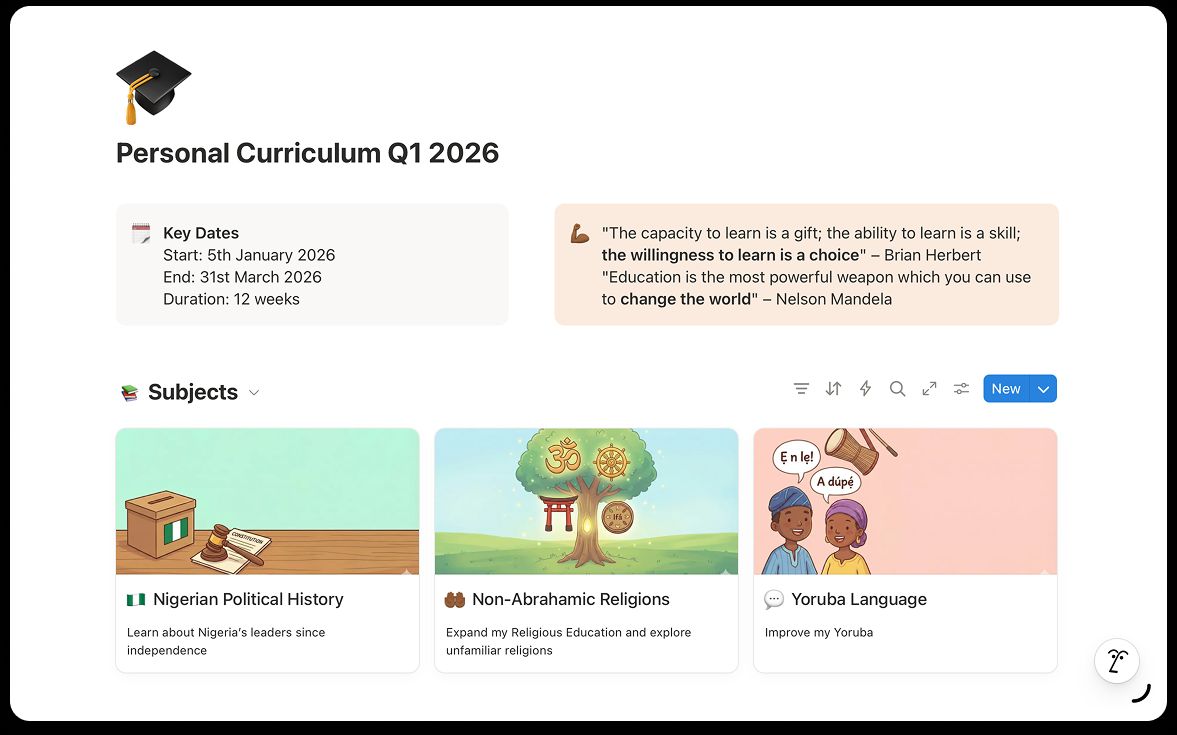
Based on these tips, I’ve created my own curriculum. Also I’m managing all this on Notion, link to a free template at the end of the article if you’d like to recreate it.
Subjects
I’m learning three topics, which I think follow on naturally from what I’ve been reading and learning last year.
- Nigerian Political History - We have a presidential election next year and my goal is to be a lot more informed to vote than I have been previously. In order to do this, I think I need to first have a better understanding of our political history, and so I want to learn about Nigeria’s leaders since independence.
- Non-Abrahamic Religions - I grew up in a mix of Christianity and Islam, so those religions have dominated my view of religion as a whole. Since reading the book on world views, I’ve wanted to expand my understanding of religions outside the Abrahamic ones.
- Yoruba Language - This has been a long-standing goal of mine to improve my understanding and speaking of my native language, Yoruba.
Course content
For the course content, I’m following my own advice and keeping things relatively open. I have put together a few resources I’m already going through, but allowing myself to adapt the content as I go.
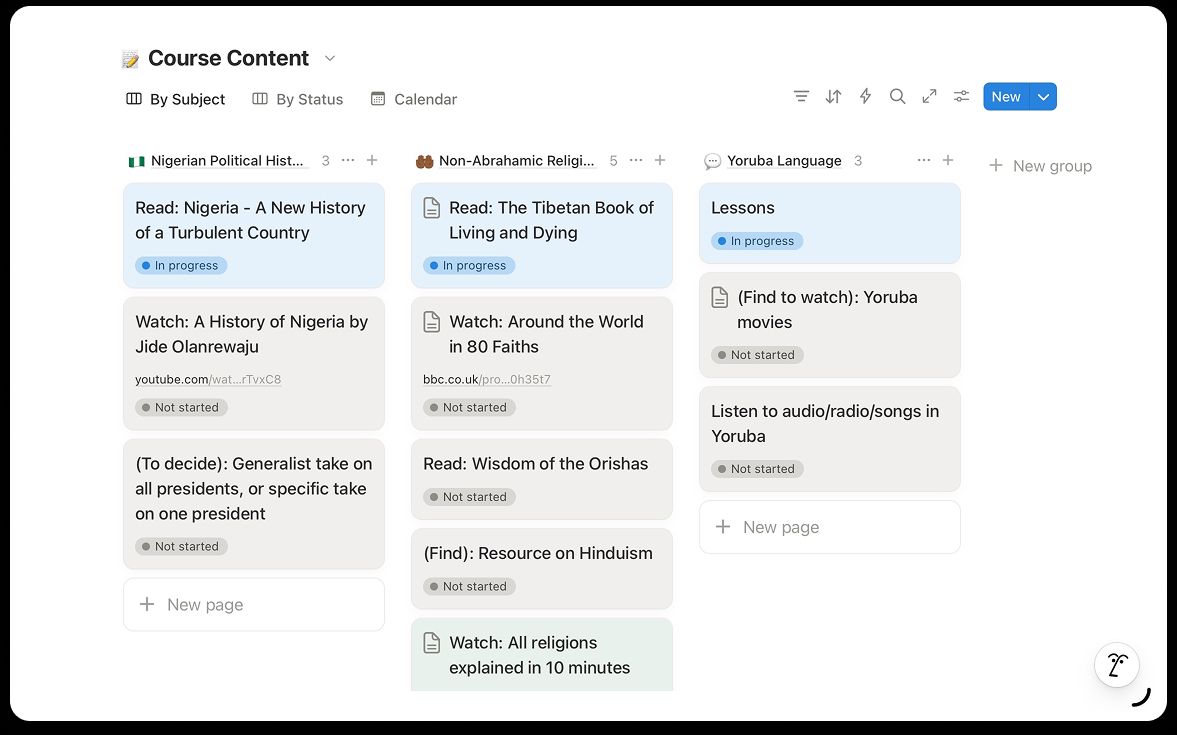
On Nigerian Political History, I’ve already started a book on the history of the country as a whole. From here, I will decide if I want to go a more generalist route and have a surface-level understanding of each presidency, or do more of a deep dive on one or two particular presidents.
On Non-Abrahamic Religions, I just finished The Tibetan Book of Living and Dying, which gave me a really good understanding of Buddhism. Next, I I’d like to deep-dive into Hinduism and also look at the ancient Yoruba religion Ifá. This may be through books or documentaries.
On Yoruba Language, I’m primarily doing lessons, but here I will also throw in alternative media in the language - movies, songs, etc.
If you have any recommendations for content I should be looking at for any of these topics, please let me know!
Assignments
I’ve also not 100% defined these, so this will evolve as my course plan evolves, but the idea will be to create some content around each of the three topics.

I'll likely share some of these here, so stay tuned :)
🆓 Free Resource - Notion Template
If you're interested in this concept, I've created a Notion template you can use to manage your own personal curriculum.
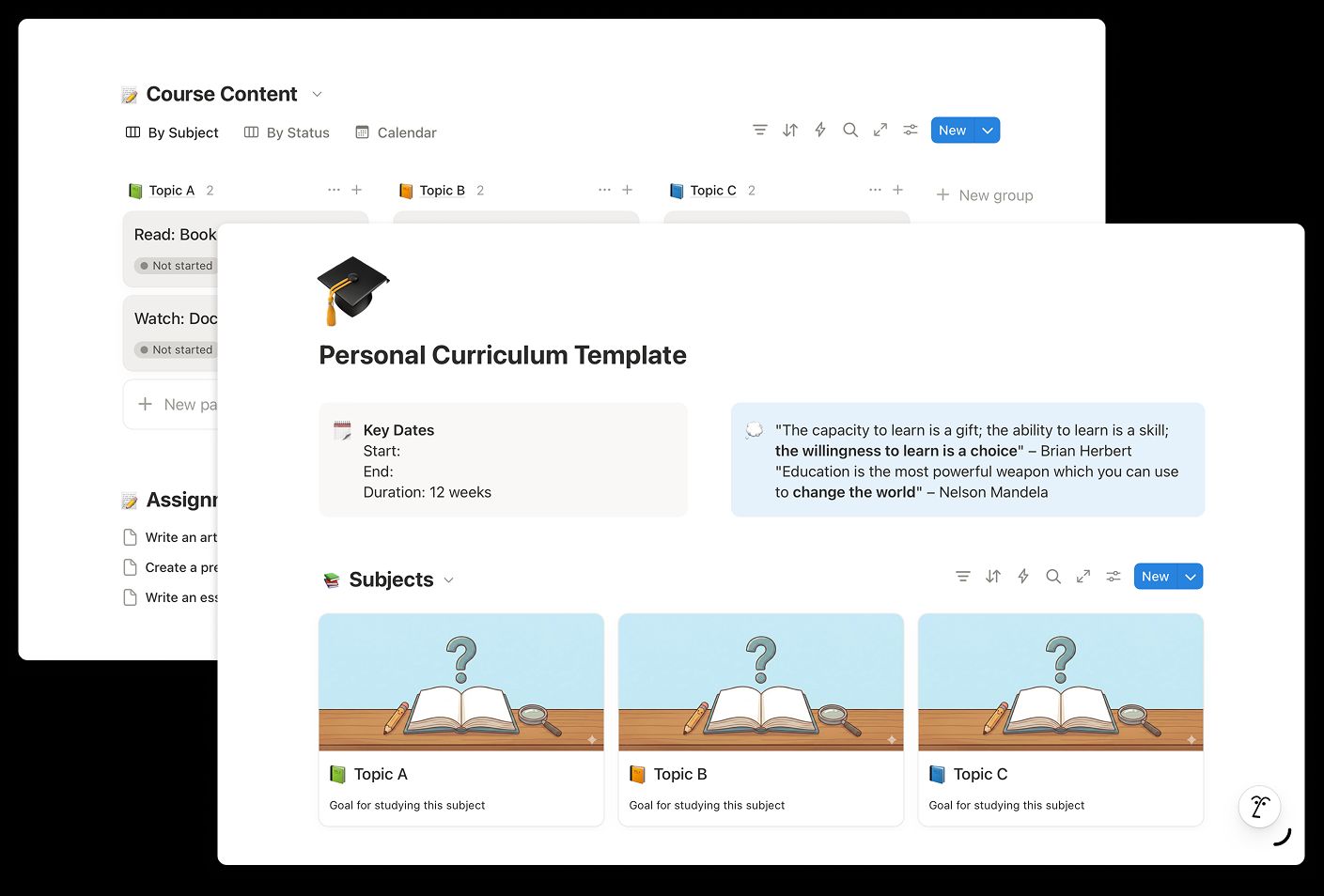
👉🏾 Get the free Notion template here
If you do end up creating a personal curriculum, I'd love to hear about it!